
Nexora
Business operations platform · 2026
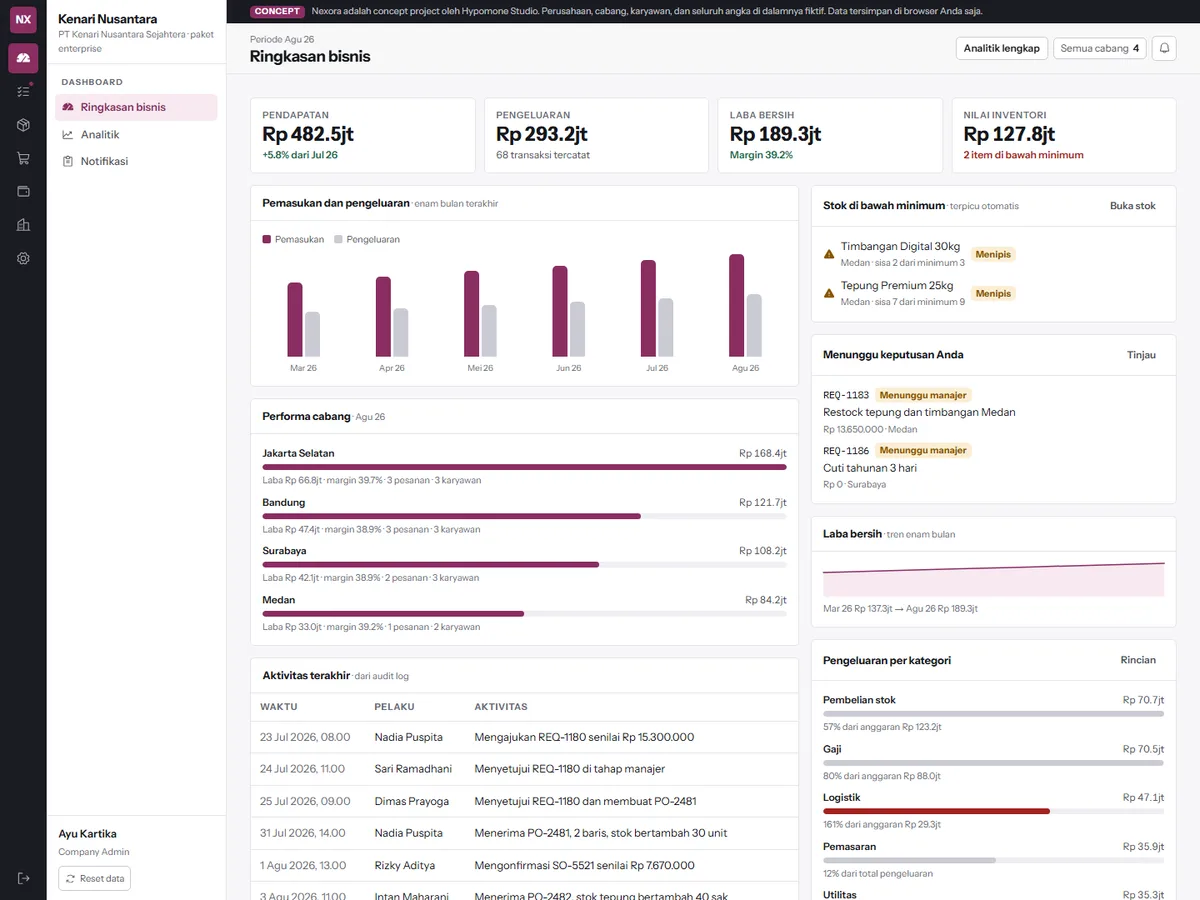
One system for a company running several branches, where a single approval moves inventory, the ledger, and the dashboard at once.
Business context
A company with four branches was running each one on different tools: staff on spreadsheets, stock in a separate app, expenses in a third, and nothing joined up. Management could not answer which branch was most profitable this month without someone spending a day collecting numbers by hand.
The problem
The real cost was not the missing report. It was that every branch could tell a different version of the same month, and nobody could prove which was right. Decisions were being made on whichever spreadsheet arrived first.
The challenge
A system like this fails in two ways. It either buries people in modules nobody opens, or it lets one action update part of the business and quietly skip the rest — a purchase received in the warehouse that never reaches the books. The second failure is worse, because it looks like it is working.
The solution
Every state change goes through a single operations layer instead of the screens. Approving a purchase request as finance closes the request, issues the purchase order, and records who decided it — one operation, so it cannot be done halfway. Receiving that order then moves stock, logs a movement per line, books the expense, notifies finance, and writes the audit entry together.
Design approach
This is a tool people sit in all day, so it is built for scanning rather than for impression: one 5px corner radius everywhere, a mono face for codes and rupiah columns so figures line up vertically, and colour reserved for status. The chrome is a narrow icon rail plus a section panel, which keeps seven modules reachable without a menu that grows.
Technical approach
Next.js and TypeScript, with the business rules isolated in one module so they can move to a server unchanged. The demo stores its data in the browser: it opens instantly, needs no keys, and cannot rot — but every screen says so, and the audit page is explicit that a real build writes its log to append-only storage that an administrator cannot edit.
Key features
- Five roles that each see a different product, generated from a permission matrix rather than hard-coded per screen
- Two separate checks on every action: may this person do it, and may they do it in this branch
- Multi-tenant, with a second company in the data specifically so the isolation can be tested rather than claimed
- Two-stage approval flow — branch manager, then finance — that issues a purchase order on final approval
- Automatic low-stock alerts that fire the moment a sale drops a product below its minimum
- Audit log that cannot have gaps, because nothing can be written without it
- Dashboard and financial reports recomputed from the underlying rows, never stored as summaries
Yours is the one we want to build.
Each of these was shaped around what one business actually needed. Yours would start the same way — with a conversation about the business, not a brief.